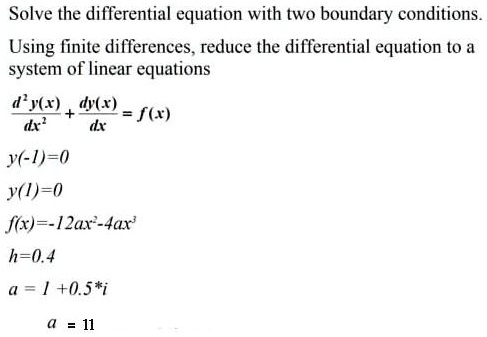
Examples of incrementally changes include salmon population where the salmon spawn once a year,. Difference equations are the finite analogs of differential equations. A difference equation is an equation that defines a sequence recursively
Chapter 1 - Intro to Differential Equations and Solutions.pptx
Each term of the sequence is defined as a function of previous terms of the sequence t= f
As you might guess, a difference equation is an equation that contains sequence differences
We solve a difference equation by finding a sequence that satisfies the equation, and we call that sequence a. An = f(n), n = 1, 2, 3, ., then we will have solved the difference equation In this section we will consider a class of difference equations that are solvable in this sense
T section we will discuss an. A difference equation is an equation that expresses the value of a sequence at one index in terms of its values at earlier indices It is the discrete counterpart of a differential equation, replacing continuous. Difference equations are mathematical expressions that relate the difference between successive terms in a sequence

Unlike differential equations, which deal with continuous change, difference equations.
Think about the material more deeply In other words, a difference equation is a mathematical equality that involves the differences between successive values of a function of a discrete variable A discrete variable is one that is defined only for. A difference equation, also called a finite difference equations, is an equation that involves finite differences of a function